 Menu
Menu

 Account
 Cart
CartChapter 1~ Pixelated Landscapes
The Revelations of Resolution
In this section we will examine what appears to be a range of landscapes that are glitched, pixelated, or moiré in order to determine what these accidental aesthetics can achieve by way of introducing asynchronies in the matrix of the place that is being represented. In his essay “Holy Landscape: Israel, Palestine, and the American Wilderness” WJT Mitchell exposes the natural beauty of landscapes as a veil that disguises the violence underneath. Mitchell writes, “Even more insidious is the remarkable capacity of the surface of landscape to open up false depths, selective memories, and self-serving myths.”2 Following Mitchell’s injunctions, the works here read landscape against its grain for signs of amnesia and erasure. Chinar Shah’s pixelated landscapes are isolated from the background of images found online recording the assassination of the Russian ambassador Andrei Karlov by an off-duty Turkish police officer at a photography exhibition in Ankara entiled ‘Russia through Turks’ Eyes’ on 19th December 2016. The assassin allegedly shouted ‘Allahu Akbar. Don’t forget Aleppo. Don’t forget Syria’ before shooting the ambassador at point blank range in a testament to the political tensions rife between the two nations fighting on the opposite sides in the Syrian Civil War, the Russia-backed Assad Regime having had just scored a major victory at Aleppo. These images shot by the photo journalist Burhan Ozbilici were among the most iconic that year.
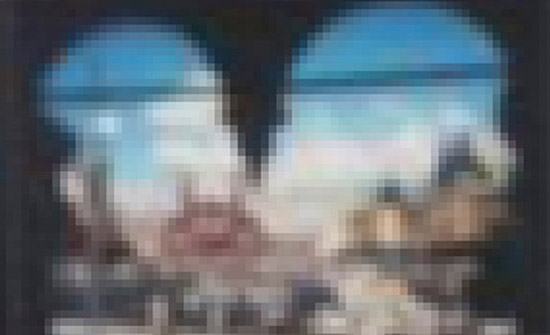
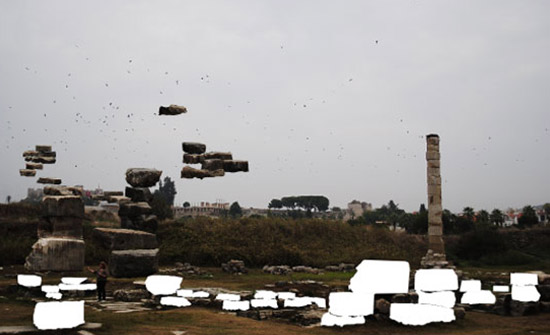
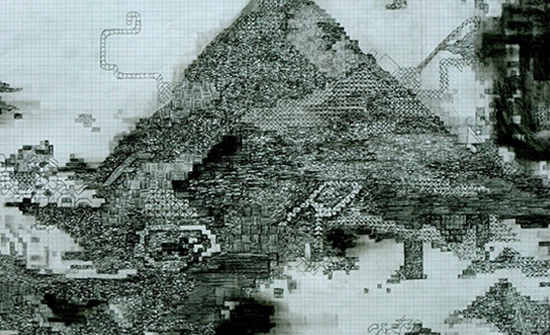
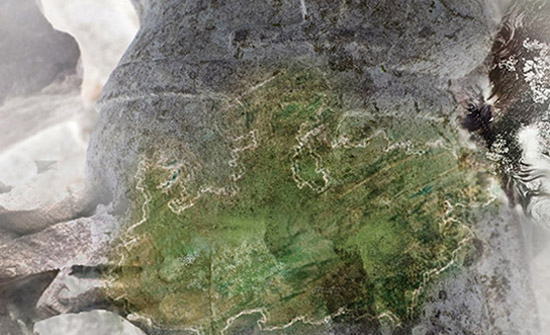
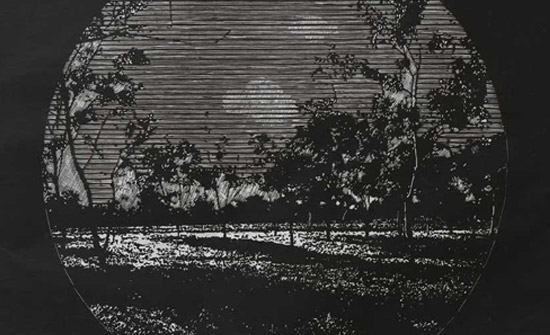
In this section we will examine what appears to be a range of landscapes that are glitched, pixelated, or moiré in order to determine what these accidental aesthetics can achieve by way of introducing asynchronies in the matrix of the place that is being represented. In his essay “Holy Landscape: Israel, Palestine, and the American Wilderness” WJT Mitchell exposes the natural beauty of landscapes as a veil that disguises the violence underneath. Mitchell writes, “Even more insidious is the remarkable capacity of the surface of landscape to open up false depths, selective memories, and self-serving myths.”2 Following Mitchell’s injunctions, the works here read landscape against its grain for signs of amnesia and erasure. Chinar Shah’s pixelated landscapes are isolated from the background of images found online recording the assassination of the Russian ambassador Andrei Karlov by an off-duty Turkish police officer at a photography exhibition in Ankara entiled ‘Russia through Turks’ Eyes’ on 19th December 2016. The assassin allegedly shouted ‘Allahu Akbar. Don’t forget Aleppo. Don’t forget Syria’ before shooting the ambassador at point blank range in a testament to the political tensions rife between the two nations fighting on the opposite sides in the Syrian Civil War, the Russia-backed Assad Regime having had just scored a major victory at Aleppo. These images shot by the photo journalist Burhan Ozbilici were among the most iconic that year. By moving away from their iconicity and foregrounding the original landscapes that formed a backdrop to the infamous event, Shah exposits a complexity of gaze and irony characterising Russia through Turks’ eyes. The found-blown-ups of these landscapes thrice-removed, break away from the conventional aestheticising distance by zooming in on details that refuse to come into resolution, provoking the viewer into an inverse deduction from the landscape to the specific event to the broader political scenario. Mustafa Khanbhai’s Cappasofya glimpses into the Hagia Sophia, the celebrated Byzantine architectural marvel that has seen multiple lives as a cathedral, a mosque and a museum, layering it with different geographies that have been implicated by its institutional edifice. The inside of the cathedral is collaged over with aerial views of the terrain of Cappadocia, a region whose soft volcanic rocks and confounding topography provided ready shelter to early-Christian refugees fleeing Roman persecution. The Name of the Hunted I & II and The Name of the Hunter I and III display a similar treatment of landscape except, here the terrain of Cappadocia is overlaid with ruins of another faith and inscribed with various names of Artemis, one of the most appropriated figure in ancient religions from Europe and Asia Minor, in a fictional cuneiform script. Artemis’ temple in Ephesus in Cappadocia was one of the seven wonders of the ancient world. As such the work peels over layers of history to uncover pre-existing cultures that got caught in the crosshairs of Christianity. In fact, in Romans Saint Paul of Tarsus denounced pagan worship and free expressions of sexuality that went with it while the Acts of Apostles mentions the Ephesian metalsmiths who rioted against Paul on grounds that Artemis, whom Asia and all the world revere may soon be stripped of her magnificence.3 Here’s a layered narrative of the once hunted Christians turning on the great goddess of hunt. The assumption of Artemis’ remains appears to be an unavailing artistic attempt at re-assembling the 121 columns of the ancient temple of which only one stays standing to mark the location of the site where history has recorded many-a-wounds. By offering a complex account of warring myths and memories Khanbhai hacks into the unmarred face of landscape that tends to supress any signs of struggle. Similarly, Nobina Gupta’s Dharohar series as a continuation of her ongoing socially-engaged project ‘Disappearing Dialogues’, unfolds a changing cultural landscape of Bundelkhhand and Baghelkhand in Madhya Pradesh. By posing questions such as ‘Whose dharohar or heritage?’ the artist calls out our understanding of history as selective and partisan, actively repressing a plethora of material, knowledge and perspectives. By superimposing images of ruinous sculptures over antiquarian maps of the region, Gupta analogises history as a composite tapestry of objects, dynasties and narratives vying for space in its annals. Nilanjana Nandy’s choice of the grid for cross-hatching her landscapes is interesting, not least because of its deployment in mapmaking, colonial expansion, militaristic strategising, civil construction and urban planning. As such grids and contour sheets provide the primary surfaces for rehearsing and enacting edicts that are then transferred to the indexed land in the form of diktats, bans, and law. By appropriating this device of power for her landscapes, Nandy studies its effects on the renditions of a place, consciously exploring the movement between the grid as confinement/imposition and as a spatial possibility /playfield. Chandan Bez Baruah’s woodcuts frames anonymous landscapes somewhere in the North East of India, a region that has been deemed ‘disturbed’ under the provisions of the Special Powers Armed Forces Act for close on six decades, leading to gross human rights violations and widespread disaffection. Alien and inhospitable, the natural features in these landscapes are put into stark relief by horizontal black bands stretched horizontally across the sky and parallel to the horizon. These conjure shifting visual gestalt and a sense of foreboding roiling under the deceptive normalcy of the landscape, a terror lurking just around the corner of the eye and waiting to burst out like a startled flock of ravens any moment.
WJT Mitchell, “Holy Landscape: Israel, Palestine, and the American Wilderness” in Landscape and Power, 2nd ed.. Chicago, The University of Chicago Press on behalf of Wenner-Gren Foundation for Anthropological Research, (1994) 2002, pp. 263.
WJT Mitchell, “Holy Landscape: Israel, Palestine, and the American Wilderness” in Landscape and Power, 2nd ed.. Chicago, The University of Chicago Press on behalf of Wenner-Gren Foundation for Anthropological Research, (1994) 2002, pp. 263.

 @knownunknown.art