 Menu
Menu

 Account
 Cart
CartChapter 2~ Materiality
Recoding the Matrix
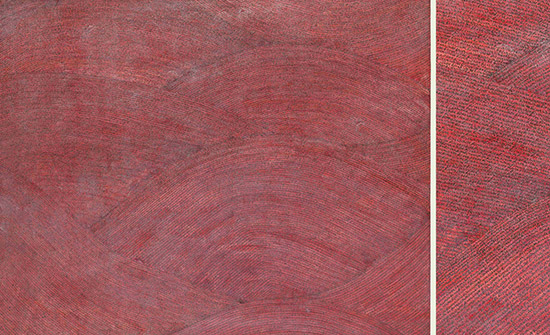
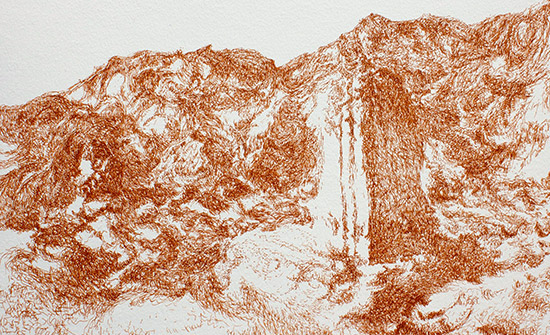
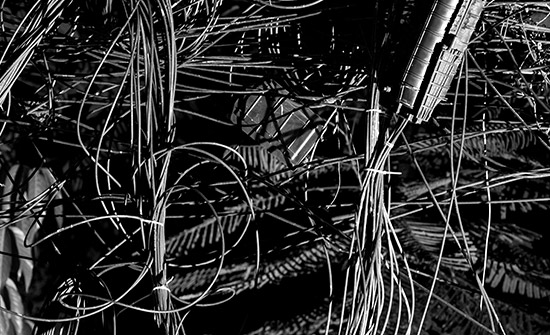
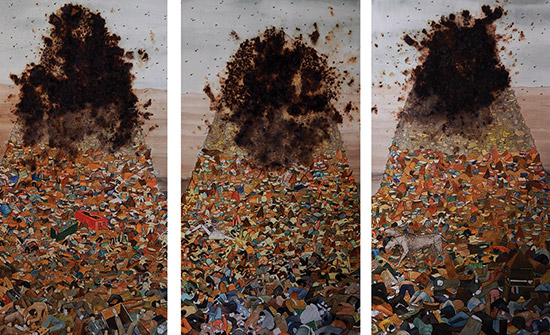
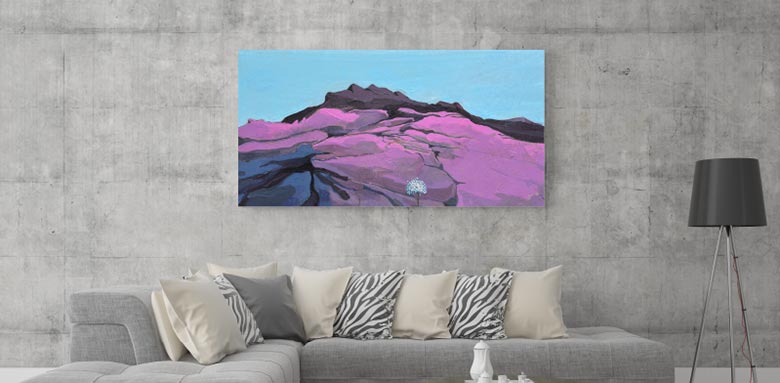
The works in this section utilise individual strokes to re-configure the matrix of traditional landscape paintings. Upon closer examination the mark making in these works resolve into unconventional constituent units – whether it is text, technological entrails, or anthropogenic refuse. Priyanka Govil’s landscapes highlight the complicity of the written word in denoting, shaping, and framing of landscapes. Landscapes understood as imaginary representations of places activated by the symbolic have deep entanglements with semiotics and language. Whether it is a sacred grove or a military encampment with restricted access, or a place with special literary, religious, or historical significance landscapes are inscribed with meaning, quite literally. By lacing her landforms with poetic utterances, Priyanka Govil renders visible these latent textual underpinnings of landscapes as well as their inherent performativity. In works such as The White River repetitions of the counterintuitive appelation to designate what could be a red desert with gently rolling dunes, seem like a ludicrous attempt to enforce a meaning that doesn’t fit, whereas in reality meanings and borders are assigned as arbitrarily and often. The work flouts the standard conventions of framing and composition such that the texture gives way to textuality while the form evokes viscerality. Puja Puri’s lightly scribbled landscapes seem delicately ephemeral like dandelions dehiscing at a touch and dispersing on the wind to deposit into other forms at other places.
The works in this section utilise individual strokes to re-configure the matrix of traditional landscape paintings. Upon closer examination the mark making in these works resolve into unconventional constituent units – whether it is text, technological entrails, or anthropogenic refuse. Priyanka Govil’s landscapes highlight the complicity of the written word in denoting, shaping, and framing of landscapes. Landscapes understood as imaginary representations of places activated by the symbolic have deep entanglements with semiotics and language. Whether it is a sacred grove or a military encampment with restricted access, or a place with special literary, religious, or historical significance landscapes are inscribed with meaning, quite literally. By lacing her landforms with poetic utterances, Priyanka Govil renders visible these latent textual underpinnings of landscapes as well as their inherent performativity. In works such as The White River repetitions of the counterintuitive appelation to designate what could be a red desert with gently rolling dunes, seem like a ludicrous attempt to enforce a meaning that doesn’t fit, whereas in reality meanings and borders are assigned as arbitrarily and often. The work flouts the standard conventions of framing and composition such that the texture gives way to textuality while the form evokes viscerality. Puja Puri’s lightly scribbled landscapes seem delicately ephemeral like dandelions dehiscing at a touch and dispersing on the wind to deposit into other forms at other places. By assuming this disintegrative quality, the works appear to unravel the fabric of eternity that composes landscape paintings. While closely studying the sites of certain ruinous temples and Gurudwaras in Pakistan, the artist deliberately chose to meld these ruins with their purlieu not only to emphasise the impermanence of landscapes, calling into question their naturalising function but also to highlight the luminous glory of land that doesn’t require any human markers for its embellishment. Sounak Das’ night-time photography on the streets of Dhaka, is an abject take on urban-scapes. The convoluted assemblage of cables, transformers, insulators and pylons remain largely unassimilated in our visual economy such that the average city-dweller looks right through them. By rendering visible this technological ontology that subtends the marvels of the cyber omniscience and electric omnipotence, the artist salvages this supporting paraphernalia from the margins of our vision, making it the central subject of reflection. In a similar vein, Ravi Chaurasiya alights his frame on the man-made topographies of abjection that are the rearing mounds of rubbish that have mushroomed around chief metropolitan centres, three such being in the suburbs of Delhi itself. The massive landfills provide a marker for modernity and its insatiable hunger for consumption. The scale and presence of these geographies of waste is so imposing that it makes sense to speak of them in terms of anthropogenic landscapes. By begging our attention to these man-made features, the artist calls upon us to take full stock of our actions that appear to carry out as if by an alien will, unmindful of ramifications.

 @knownunknown.art