 Menu
Menu

 Account
 Cart
CartChapter 4~ Landscapes of Memory
Personalising History
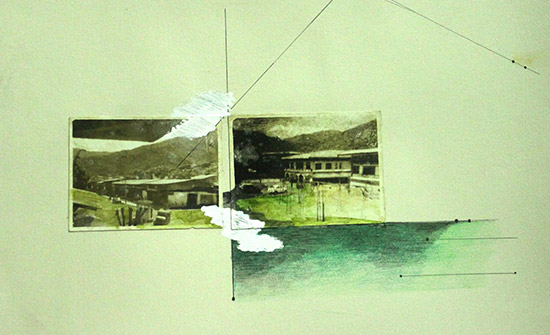
Not unlike Tehmeena Firdos, Jayeti Bhattacharya attempts to break the two dimensionality of her found landscapes by intervening on their surface with drawn lines and shaded planes. By personalising this archive of photographs inherited from her parents and relatives, the artist hopes to reclaim and address the memories of some of the places visited by them in their youth. Thus, her drawing practice becomes a way for her to time-travel to distant locations, make comparisons and illustrate time’s attrition. These photographs also open backdoors into memories of others, allowing her to vicariously inhabit multiple perspectives while engaging these in a creative dialogue. By smudging and adding details according to her artistic volition, by juxtaposing different visuals and by selectively accentuating them, the artist shakes them loose of their original meaning, formulating new narratives for locations that are old. The ghost lines that dominate Jayeti Bhattacharya’s works also find their way in Bhanu Pratap’s diptychs inspired from an ancient Chinese idiom of expressionistic landscapes executed with ink on paper and dating back to the 5th century CE, the Shan Shui. Executed by the artist during the course of a residency in Hangzhou, just south-west of Shanghai, these landscapes are temporally disjointed. In Inevitable Setup, one has what appears to be a pristine countryside, a traditional setting for a Shan Shui painting, except for the small detail of modern transmission cables zig-zagging across the middle distance.
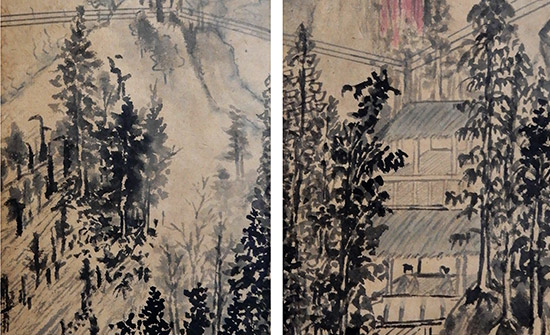
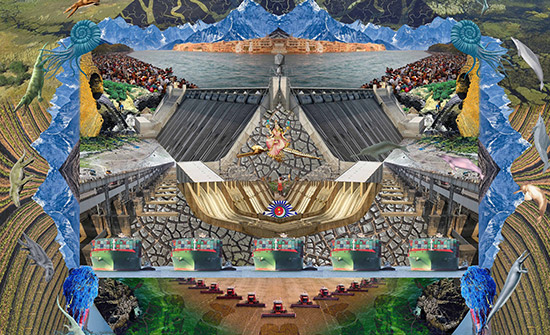
Not unlike Tehmeena Firdos, Jayeti Bhattacharya attempts to break the two dimensionality of her found landscapes by intervening on their surface with drawn lines and shaded planes. By personalising this archive of photographs inherited from her parents and relatives, the artist hopes to reclaim and address the memories of some of the places visited by them in their youth. Thus, her drawing practice becomes a way for her to time-travel to distant locations, make comparisons and illustrate time’s attrition. These photographs also open backdoors into memories of others, allowing her to vicariously inhabit multiple perspectives while engaging these in a creative dialogue. By smudging and adding details according to her artistic volition, by juxtaposing different visuals and by selectively accentuating them, the artist shakes them loose of their original meaning, formulating new narratives for locations that are old. The ghost lines that dominate Jayeti Bhattacharya’s works also find their way in Bhanu Pratap’s diptychs inspired from an ancient Chinese idiom of expressionistic landscapes executed with ink on paper and dating back to the 5th century CE, the Shan Shui. Executed by the artist during the course of a residency in Hangzhou, just south-west of Shanghai, these landscapes are temporally disjointed. In Inevitable Setup, one has what appears to be a pristine countryside, a traditional setting for a Shan Shui painting, except for the small detail of modern transmission cables zig-zagging across the middle distance. The phantom of modernity is stamped a little more decisively upon the rustic environs in the work Learned from Past Utopias. The asynchronous colliding of subject matter in both these cases serve as writings on the wall from a future past. By resorting to a somewhat dated oriental style of painting the artist counters the claim that views landscape paintings as a Western invention and preserve. In fact, the structural and colour conventions of Shan Shui painting exhibits a complexity, rigour and rigidity all its own. Yet what sets these apart from western landscapes is their lack of pretence at naturalness or realism which in the case of the latter is used for negating mediative agency and poetic licence. Finally, Waylon D’Souza’s digital collage maps the changes in geographical and ecological landscapes incidentally by charting the evolutionary course of the Gangetic dolphin from a petite land dweller, Indohyus major to the long snouted amphibian that we know it as, starting from the elevation of the Tethys sea into the Himalayan watershed. The species has become severely threatened on account of damming and other riverine activities by humans which disrupt its biological cycles and affect its gene pool. What is of note here is the artist’s use of sacred geography to condense and compile different factors responsible for the endangerment of Gangetic dolphins. The mandala as a format is not only inventive from the point of view of its expository potential as a pithy diagram that will have a metaphysical resonance with the local audience, but also in its ability to accommodate an inter-articulated view of events on the scale of deep time. As such the work is able to bring different temporalities, perspectives and occurrences to bear upon a particular evolutionary enquiry, that is nonetheless able to tease out some of the operational meta-contexts responsible for the issue at hand.

 @knownunknown.art